Law Firms
Specialty Practice
→
The way people search for lawyers is shifting. While Google remains important, potential clients are increasingly turning to conversational AI tools and voice assistants to ask more complex, contextual questions.
To stay visible in this evolving landscape, firms need to:
For many years, the way potential clients look for legal assistance has followed a familiar path: identify a problem, search Google, and explore a list of law firms to consider contacting. This linear pattern has formed the foundation of legal marketing strategies, with a heavy focus on search engine optimization to capture those initial queries.
Recent data, however, reveals a more complex reality. While online searches still play a major role, other factors significantly influence clients' decisions. The 2025 Legal Trends Report by Clio indicates more than half of clients have or would consider using AI to answer their legal questions. For those who have, just over half said that AI sufficiently answered it.
Referrals continue to be a significant source of new business. According to the 2024 Legal Consumer Report by Martinedale-Avvo, 45% of clients seek referrals from friends or family. This highlights the enduring significance of reputation and word-of-mouth marketing, even in the digital age.
On the other hand, online reviews, unsurprisingly, play a crucial role in the decision-making process. The same report also revealed that 70% of clients consider reviews as the most helpful element when searching for a lawyer.
The emergence of large language models (LLMs) like ChatGPT and Gemini is changing the way we discover information. Rather than simply entering keywords into a search engine, users can now pose intricate questions in everyday language and get straightforward, conversational responses.
Instead of typing “personal injury lawyer,” a user might ask:
“I was in a car accident. The other driver was at fault and I have minor injuries. What are my rights, and who should I contact?” LLM queries uncover user intent, circumstances, and the need for in-depth, contextual information. Search engines are adopting this technology too, with Google's Search Generative Experience (SGE) serving as a notable example, offering AI-driven summaries directly in search results.
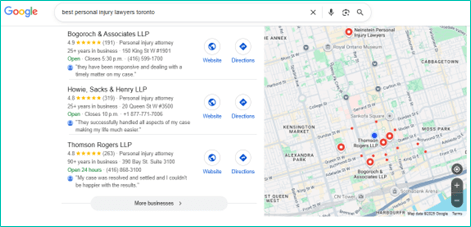 Google search results showing the Map Pack for top personal injury lawyers in Toronto ranked by client reviews and location.
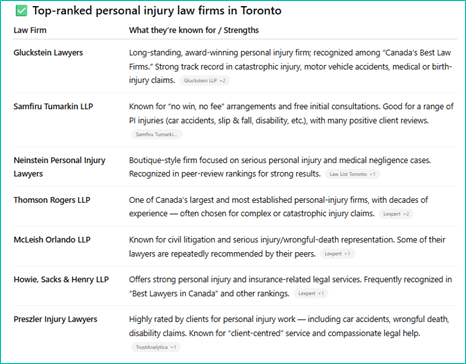
ChatGPT response of trusted Toronto personal injury firms with their expertise in personal injury cases.
The implication is clear: law firms can’t rely solely on ranking for a handful of high-traffic keywords. While good SEO would already drive steady traffic, many firms neglect proper optimizations, execute them poorly, or rely on shortcuts that hinder results. Firms must shift from keyword stuffing toward producing high-quality, authoritative content that LLMs will reference for complex queries.
According to the 2024 Legal Trends Report from Clio 79% of legal professionals have adopted AI in some way in their practice. And in the same report reveals that clients across generations would either be open to or even prefer lawyers using AI. This isn't merely a new tool; it's a fundamental shift in how individuals, including potential legal clients, seek information.
This change poses a challenge to traditional SEO methods. Previously, SEO focused on ranking among a list of ten blue links. Today, AI-powered “answer engines” often replace that list with a single, comprehensive answer. The new objective for law firms is not just to rank a link but to ensure their expertise, data, and authority are integrated and presented by the AI as part of that reliable answer.
The legal sector is beginning to recognize this significant transformation, even though the strategic responses are still evolving. This widespread recognition highlights the urgency of the situation. Firms are starting to realize that if they don't optimize their online presence for this new conversational, AI-driven search, they risk becoming invisible to the upcoming generation of clients.
The rise of voice search and AI assistants highlights how clients are increasingly seeking information through natural, conversational interactions with technology.
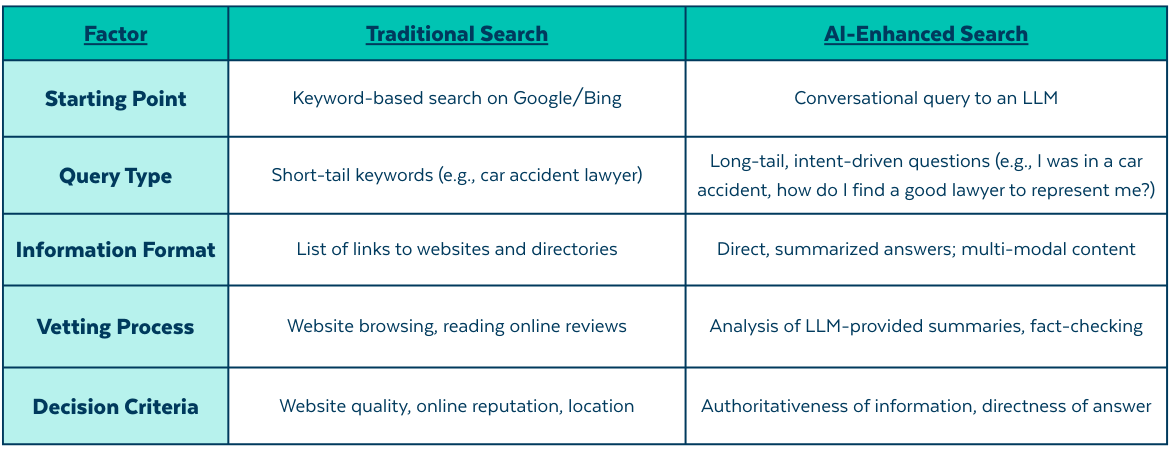
This table compares traditional search engines, which use keyword-based queries to return lists of links for users to browse, with AI-enhanced search, which responds to conversational questions with direct, summarized answers. The key difference is that AI prioritizes summarized, authoritative information over traditional ranking factors like website quality and location.
To succeed in today’s legal marketing landscape, firms need to take a proactive and strategic stance. Here’s a straightforward guide to help your firm navigate the new challenges posed by AI-driven searches and changing client behaviors.
Your content is your most valuable marketing tool. It should directly address the questions your potential clients are asking through conversational AI.
In the realm of legal marketing, establishing trust is essential. It's crucial to demonstrate your expertise, experience, authority, and reliability at every digital interaction.
*In compliance with your jurisdiction's advertising rules.
Clients take in information through different formats, so adopting a multi-modal approach can make your content more engaging and visible.
The legal industry is on the brink of significant change, largely due to the swift progress in artificial intelligence. How potential clients search for and connect with lawyers is evolving, and law firms need to adapt to this shift or risk falling behind.
To thrive in this evolving landscape, law firms must move beyond a reactive, keyword-focused approach and adopt a proactive, content-driven strategy. By truly understanding clients’ needs and producing high-quality, authoritative content in a variety of formats, your firm can position itself as a leader in the AI-powered search era.
The future of legal marketing isn’t about chasing algorithms; it’s about building trust and delivering genuine value. In a world of AI-generated responses, the firms that succeed will be those providing clear, reliable answers to the questions clients are actively seeking.
If you have questions or want to develop a tailored SEO strategy for your firm, . We're here to help you adapt and thrive in this new landscape.


We regularly partner with professional service firms to deliver marketing and design solutions backed by strategy and insight.
If you're looking for a firm that understands your challenges, has the expertise to provide real-world, actionable solutions and can turn you and your firm into rockstars, get in touch today. We'd love to hear from you.
